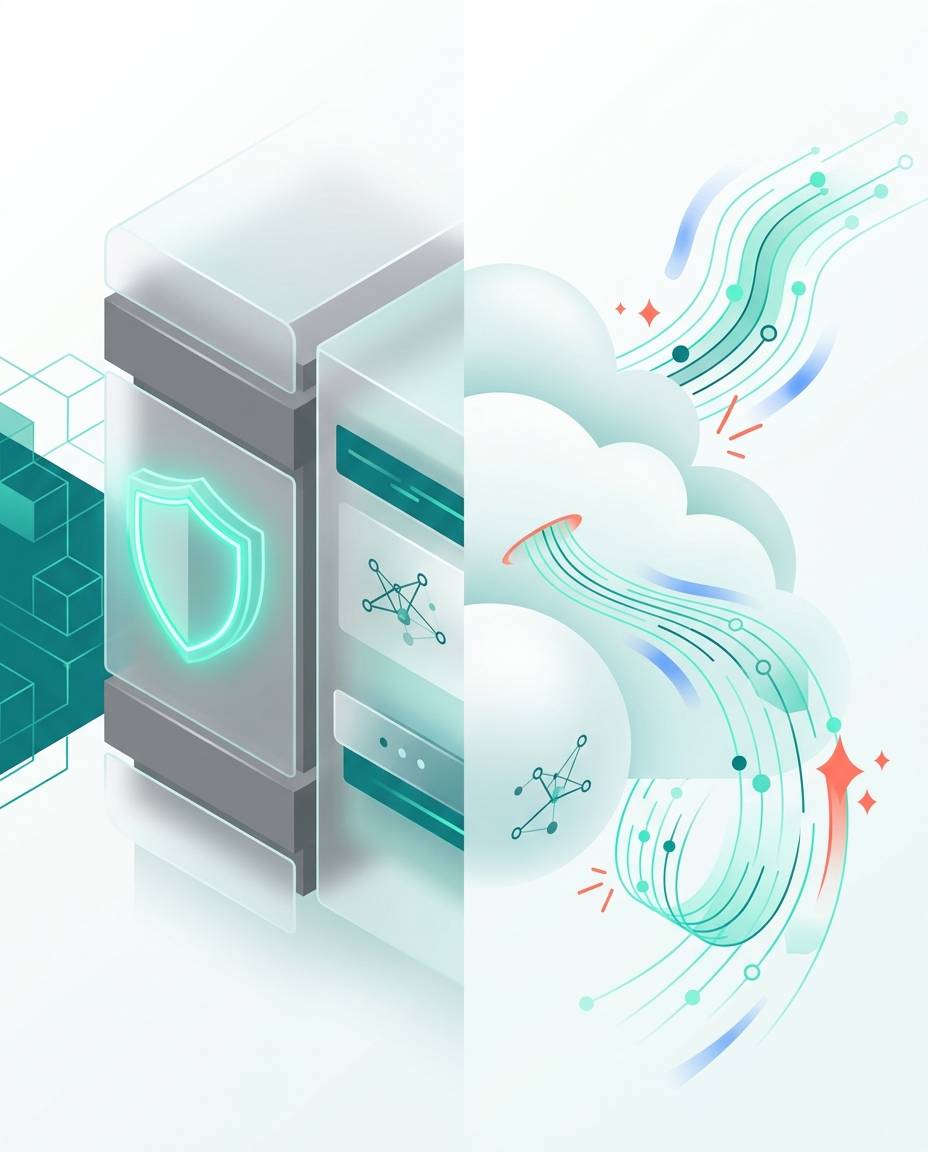
Self-Hosted vs Cloud: Choosing Your AI Agent Deployment Model — Part 3
Be A Racer Team
Author
This is Part 3 of our series "AI Agents for the Enterprise." Part 1 covered how agents differ from chatbots and RPA; Part 2 broke down the internal architecture of LLM, memory, tools, and the planning loop. Today we tackle the first question every company faces at the implementation door — "Where do we run it?"
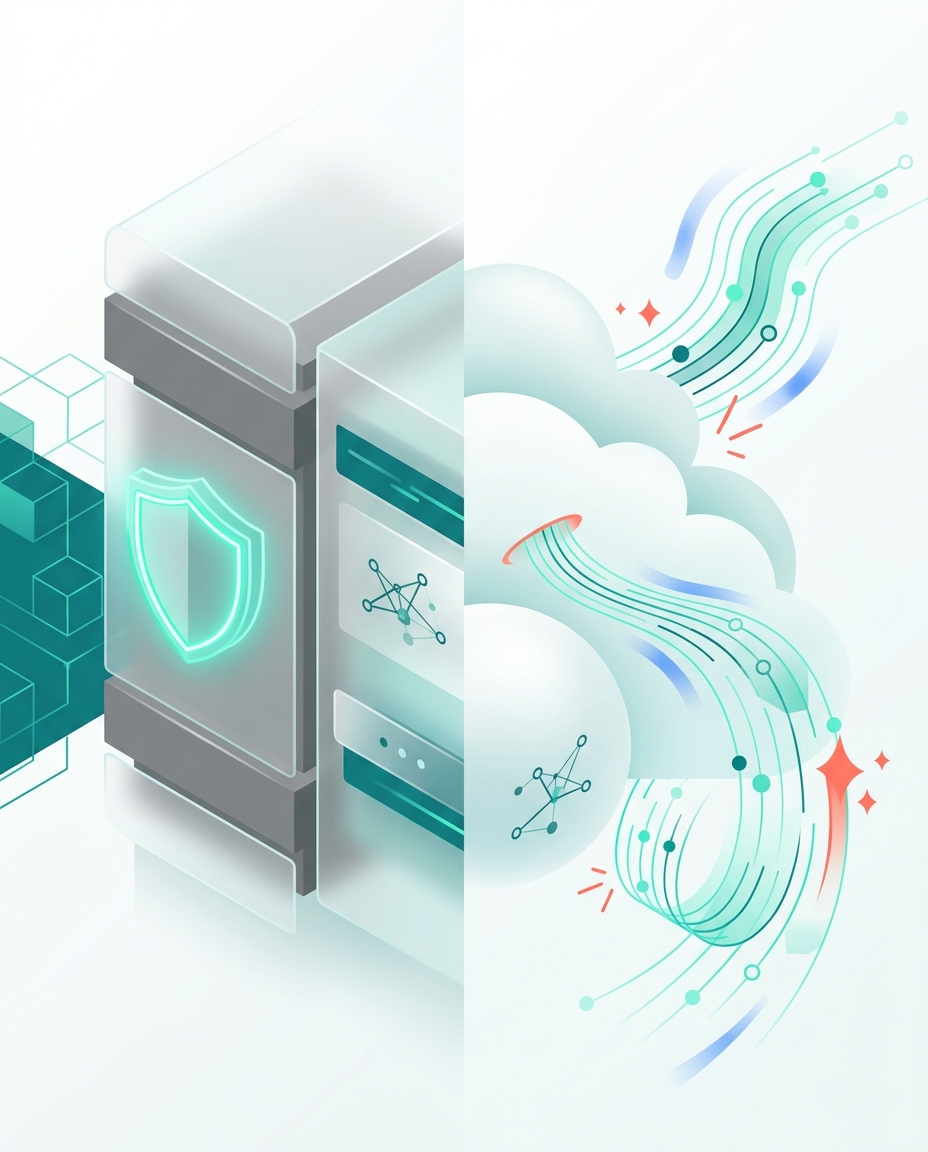
There are two broad choices: call a cloud API (OpenAI, Anthropic, Google) or self-host models on infrastructure you control. This decision has long-term consequences for security, cost, and data sovereignty. We compare all three with 2026 figures and end with the pragmatic answer for most companies.
What exactly are you hosting?
As Part 2 showed, an AI agent is not a lone LLM — it is a system binding an inference engine, memory (vector DB), a tool-execution layer, and orchestration. "Where do we run it?" actually splits into two questions:
- Model inference: use the LLM via cloud API, or run it on your own GPUs?
- Agent platform: where do the surrounding components — memory, tools, logs, data connections — live?
These are independent choices. "Cloud API for inference, on-prem for data and platform" is a perfectly valid hybrid. Let's walk the three decision axes.
Axis 1: Security and data sovereignty
The biggest concern with cloud APIs is that business data (customer info, contracts, source code) transits servers you don't own. Major vendors state they don't train on API data, but where data is physically stored and processed remains critical for compliance.
The 2026 regulatory landscape raises the stakes. Vietnam's Law on Artificial Intelligence came into force on March 1, 2026, classifying AI into three risk tiers and establishing a mechanism for governing cross-border data processing, affirming national sovereignty in cyberspace (source: LuatVietnam). In Japan, the APPI requires consent or adequacy decisions for cross-border transfers of personal data.
For workloads handling sensitive data (healthcare, finance, government, IP), keeping data on domestic, in-house infrastructure makes self-hosting a compliance comfort. For generic internal document summarization or coding assistance, a cloud API with solid data-protection terms is often enough.
The self-host edge
One guide frames the core advantages of self-hosted AI agents as four: complete data privacy, predictable costs, full customization, and independence from external dependencies (source: Self-Hosted AI Agent Guide 2026). "Data never leaves the building" is invaluable in regulated industries.
Axis 2: Cost (TCO)
A common mistake is to line up "cloud API rate × volume" against "monthly GPU amortization." Real total cost of ownership is far more multidimensional.
| Cost factor | Cloud API | Self-hosted |
|---|---|---|
| Upfront | Near zero | GPUs and servers (high) |
| Variable | Per-token usage | Power and cooling |
| Ops staffing | Low | MLOps talent needed |
| Scale | Instant, unlimited | Add hardware |
| Cost predictability | Volatile | High (mostly fixed) |
A key 2026 shift: cloud API price drops have stalled. Prices that fell sharply in 2024–2025 flattened in 2026 as frontier model costs caught up with demand (source: VDF AI TCO comparison 2026). Companies that planned around continued drops are revisiting assumptions.
The other lever is routing. The same research notes a workload costing $50K/month at frontier rates can fall to $8–15K/month by routing 70% of calls to quality-equivalent smaller local models. Routing 70% of traffic to local models cuts inference costs 60–80%.
Watch for hidden costs on both sides: cloud egress, observability tooling, retries, fine-tuning runs (cloud); cooling, depreciation, ops staffing, idle utilization (on-prem). A real comparison includes them all.
Axis 3: Customization and operational freedom
Self-hosting lets you freely choose, fine-tune, quantize, and optimize inference (stacks like vLLM or Ollama). Quantize a domain-specific small model onto commodity GPUs and you control the performance-cost balance precisely.
Cloud, conversely, gives instant access to the latest frontier models with almost no infrastructure burden. For PoCs where launch speed is paramount, cloud wins decisively. For companies without in-house MLOps talent, self-host operational load is a real risk.
The pragmatic answer: hybrid
The honest answer for 2026 is "it depends on the workload mix" — and the conclusion most companies reach is hybrid.
- High-frequency, routine tasks (document classification/summarization, standard FAQ) → route to small in-house local models. Win on cost and sovereignty.
- Low-frequency, reasoning-heavy tasks (complex analysis, rare exceptions) → use cloud frontier models.
- Processing involving sensitive data → always keep it in-house.
This routing design is the 2026 standard for optimizing security and cost simultaneously. Rather than aiming for the perfect architecture upfront, launch PoCs fast on cloud and migrate to self-host in stages as production volume and sensitivity grow.
A decision checklist
- How sensitive is your data, and which regulations apply (APPI, Vietnam's AI Law)?
- How many times will monthly token volume grow from PoC to production?
- Do you have MLOps operational capacity in-house?
- Do you prioritize launch speed or cost predictability?
- Can routing localize your high-frequency tasks?
Summary
Self-host vs cloud is not either-or. Evaluate across security, cost, and freedom, then decide the best home for each workload — that is the essence of 2026 AI agent adoption. For most companies the answer is hybrid: sensitive data and high-frequency tasks in-house, the latest reasoning in the cloud.
Next time (Part 4), we dive into department-by-department use cases — how AI agents create value in sales, customer support, operations, and development — with concrete examples. Stay tuned.
Accelerate your DX with Be A Racer
From cloud migration and AI adoption to full-stack development — we deliver the fastest digital transformation, end to end. Let's talk.
Tags
Comments
🗣️ Join the conversation
Sign in to leave a comment and join the discussion