A Practical Guide to Genba DX: How Japanese SMEs Digitize the Shop Floor to Survive the Labor-Constrained Era
Be A Racer Team
Author
"Maintaining the Status Quo Is the Biggest Risk" ― A Turning Point for SMEs
The 2026 White Paper on Small and Medium Enterprises, approved by Japan's Cabinet on April 24, 2026, sharply captures the situation facing Japanese SMEs. While spring labor negotiations continue to deliver the highest wage increases in roughly 30 years and minimum wages keep rising, SMEs have far thinner margins than large firms to fund those raises. On top of this, the white paper warns of the arrival of a "labor-supply-constrained society," in which the number of people employed by SMEs is projected to decline. Labor shortage is no longer a temporary phenomenon ― it has become a structural constraint.
At this turning point, the white paper's message is unambiguous: "Maintaining the status quo is the biggest risk." Rather than chasing short-term profit and loss, SMEs must rebuild their business and organizational structures from a long-term perspective and raise their "earning power" ― the ability to generate added value.
The white paper identifies two pillars for strengthening earning power: (1) increasing added value through price pass-through, high-value products, and business succession; and (2) optimizing labor input through AI and digitalization. The "Genba DX" (shop-floor digital transformation) that this article addresses is precisely the second pillar ― the most practical approach for producing maximum output with limited manpower.
What Is "Genba DX"? ― How It Differs from Back-Office DX
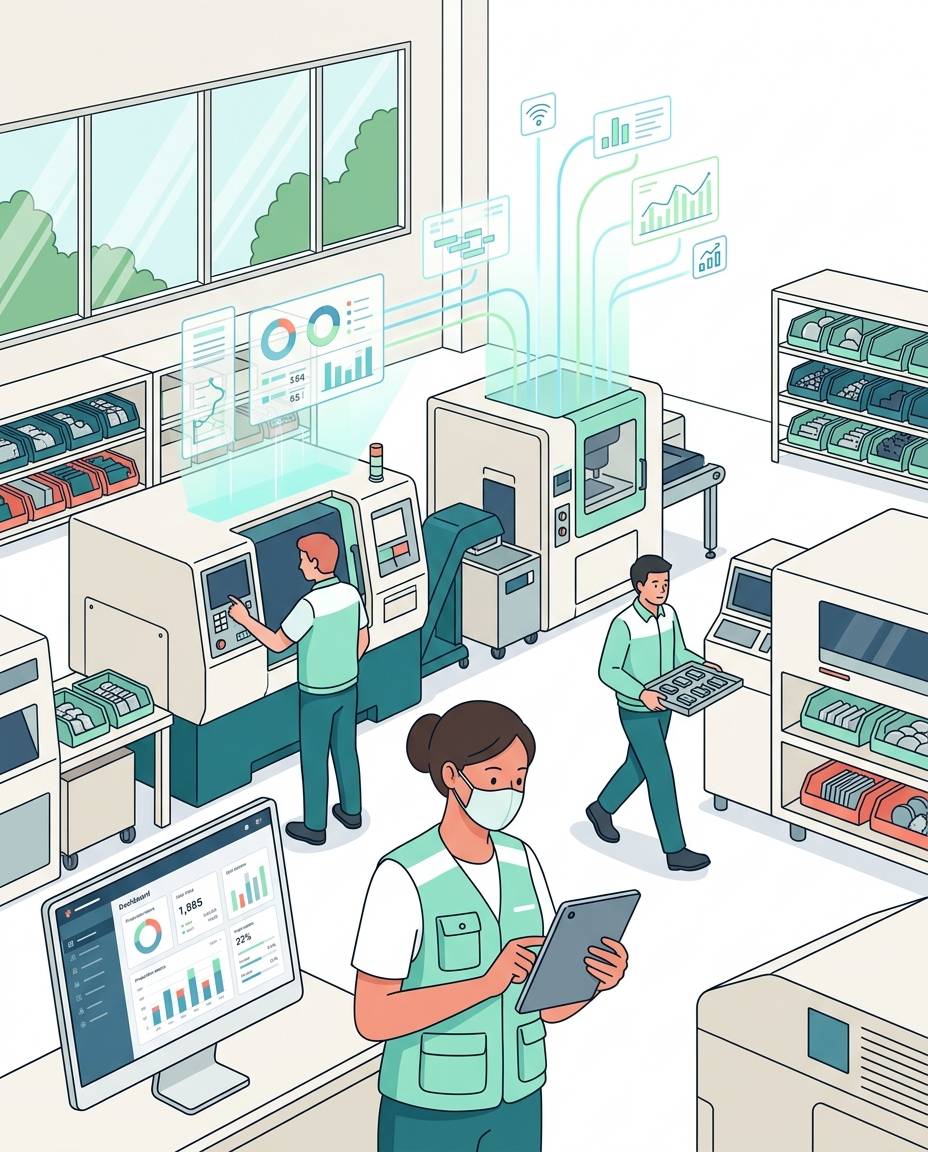
When people talk about DX, the conversation often gravitates toward the back office: management dashboards, ERP renewal, going paperless. But in manufacturing, logistics, construction, retail, and care work, the real battleground for value creation is the "Genba" ― the front line. Genba DX means using digital tools to visualize and optimize this front line: the factory line, the warehouse shelf, the construction site, the store, the care setting.
The difference can be summarized as follows.
| Aspect | Back-Office DX | Genba DX (Shop-Floor DX) |
|---|---|---|
| Target | Accounting, HR, management | Production line, warehouse, site, store, care |
| Main data source | Accounting, sales, attendance systems | IoT sensors, machine signals, on-site input, cameras |
| How value appears | Reduced indirect workload | Direct gains in productivity, quality, safety |
| Barrier to adoption | System integration, data cleanup | Engaging the floor, shifting analog culture |
The "optimization of labor input" the white paper calls for happens right here on the floor. One worker generating more added value with less burden ― that is what Genba DX unlocks.
Three Core Problems Genba DX Solves
1. Visualization ― Turning Tacit Know-How into Numbers
In many SME manufacturers, machine utilization, when defects occur, and idle waiting time exist only inside a veteran's intuition. Simply attaching IoT sensors or a lightweight monitoring device to a machine makes utilization rate, downtime, and setup time visible in real time. "Somehow we're busy" becomes the concrete question of "which process is the bottleneck."
2. Predictive Maintenance ― From "Fix After It Breaks" to "Act Before It Breaks"
Unplanned equipment stoppage is one of the most painful losses for SME manufacturers. By monitoring trends in sensor data such as vibration, temperature, and current, predictive maintenance can catch signs of failure in advance. Reducing unplanned downtime directly protects the uptime of a limited workforce.
3. Skill Transfer ― Preparing for the Retirement of Veterans
In a labor-constrained society, the most serious threat is the mass retirement of skilled veterans. Video work manuals, tablet-based work instructions, and AI-powered image inspection convert veterans' tacit knowledge into explicit knowledge, enabling young and foreign workers to maintain a consistent quality level. This is also an implementation of the "management literacy (organization and people)" the white paper advocates.
How to Advance Genba DX ― Five Steps
Most Genba DX failures stem from "suddenly rolling out an expensive system company-wide." What suits SMEs is a small start ― begin small, confirm results, then expand.
- Identify the problem: choose the single most painful process. "Do everything" is a recipe for failure. Focus on one point of clear pain ― a machine that stops often, a process where defects concentrate.
- Acquire data: use retrofit IoT sensors or existing PLC signals to collect numbers first. Expensive new equipment is often unnecessary.
- Visualize: make the collected data visible to everyone on the floor via a dashboard. The moment numbers are shared, the conversation about improvement begins.
- Improvement cycle: run small, floor-led improvements against the visible bottleneck. This is where Japan's strength ― Kaizen ― comes alive.
- Horizontal deployment: replicate the success pattern from one point to the next line or another site. Only here does ROI reach company-wide scale.
Genba DX is about "accelerating Kaizen with digital." The improvement capability Japanese shop floors have cultivated for decades ― backed by data and given speed ― that is its essence.
Keys to Success and Common Pitfalls
Key to success: the protagonist of Genba DX is not the IT vendor but the floor worker. The dividing line is whether the tool feels like something "imposed on us" or "something that makes our own work easier." Engaging key people on the floor early and sharing small wins is the shortest route to lasting adoption.
Pitfalls: (1) "visualization dead-end," where data is collected but never used; (2) "tool-first," imposed top-down without listening to the floor; (3) "over-spec," installing a system beyond your means just because a subsidy exists. All are classic patterns of wasted investment.
Genba DX Works Precisely Because You Are an SME
SMEs, with their fast decision-making and short distance between the floor and management, are actually well-suited to Genba DX. Without the complex approval processes of large firms, an owner can decide "let's start with this one machine." As the white paper shows, there is data that firms adopting AI and digitalization achieve both increased added value and optimized labor input compared with those that do not.
A labor-constrained society will not resolve itself by waiting. But an SME armed with Genba DX can transform into a "strong SME" that generates high added value even with fewer hands. Start by visualizing, in numbers, the single most painful process on your floor ― that is where the first step of Genba DX begins.
Accelerate your DX with Be A Racer
From cloud migration and AI adoption to full-stack development — we deliver the fastest digital transformation, end to end. Let's talk.
Tags
Comments
🗣️ Join the conversation
Sign in to leave a comment and join the discussion